Research and Concept Development – The Most Critical Phase of a Project
19/09/2024
During his long career, Product Development Manager Rami Raute has become well versed in a range of ideation methods and product development processes. In this article, he examines what matters most in product development projects. How should projects be approached when there are no straightforward answers and new or unknown factors play a significant role?
With the rise of lean culture, agile development models have become part of everyday product development. Yet it often feels as though something essential is still missing when it comes to developing a product’s value and substance. Product development processes and methods have been studied and refined for decades. One might assume that the most critical stages of development would already be well understood. Nevertheless, the same problems continue to affect development initiatives and product development projects.
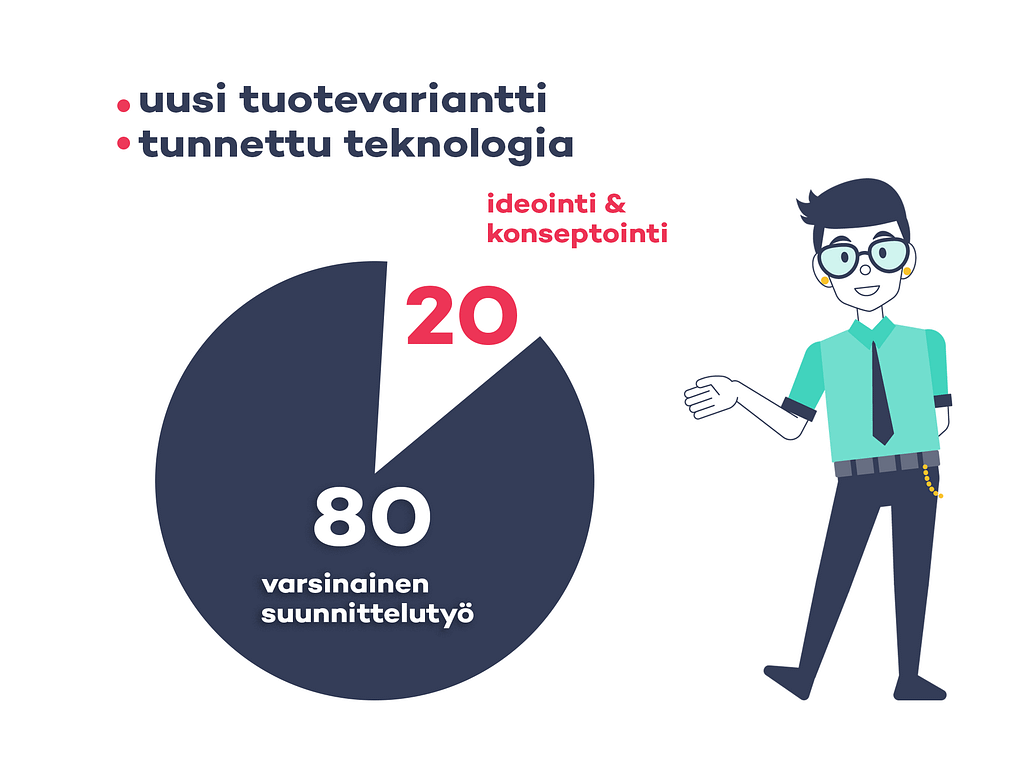
20/80 – A New Product Variant
When developing a new product variant or a new product in which the project focuses on detailed design, the product development project is typically structured as follows:
First, the goals for the future product are considered, i.e., a product specification is created.
Based on the product specification, a range of ideas and concepts is developed to describe or establish a concrete vision for the new product. A significant proportion of the solutions and technologies to be used are already known.
In such a project, ideation and concept development account for 20%, while actual design work accounts for 80%.
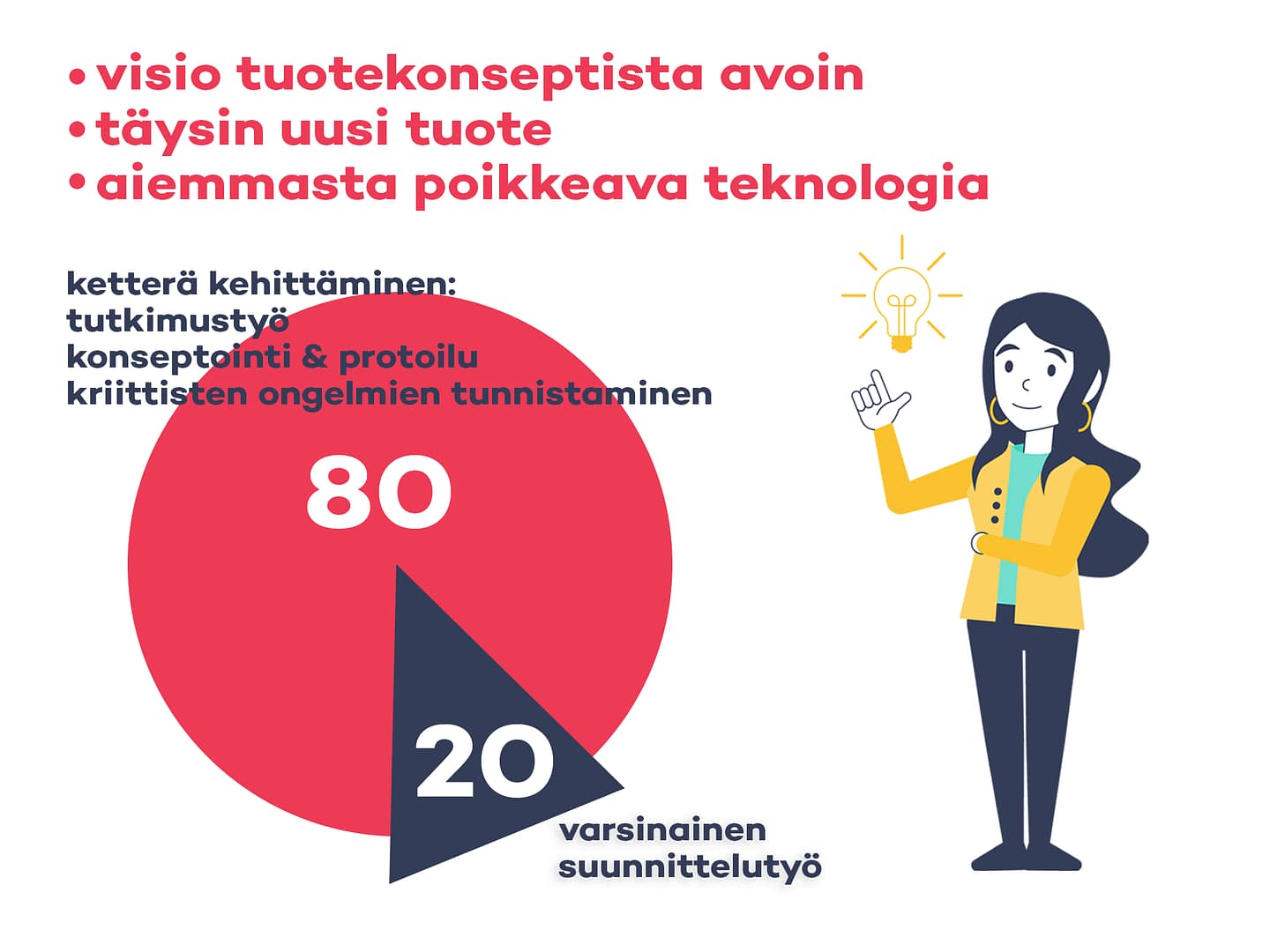
80/20 – An Entirely New Product
What if it is a matter of creating an entirely new product? If the product’s core essence and technologies differ radically from previous ones, a new approach is required.
We only know the core objectives of the future product
The vision for the product concepts is missing or remains largely open.
It is easy to see that substantially more concept development and ideation are needed—so much so that it may be difficult to identify the exact point at which the project moves into detailed design. In his book on Toyota product development, Jeffrey Liker extensively describes a product development model that has long been used in Japan. In this model, the development phase consists of 80% parallel development and 20% efficient, simultaneous technical design based on well-defined concepts.
In the model described by Liker, the emphasis is on parallel development during the early stages, identifying critical problems, and developing solutions. In other words, the project’s most critical phase is the time and resources devoted to research and concept development. Particular emphasis is placed on ensuring that the proposed solutions are of sufficient quality. Agile development and prototyping methods make it possible to develop different elements in parallel during the concept development phase. Their feasibility and readiness for detailed design can then be verified. The method also quickly reveals whether any area under development is particularly demanding in relation to the overall project or likely to affect the schedule.
Finnish industry, and particularly the manufacturing industry, faces constant demands to improve efficiency and manufacturability. In my opinion, companies developing products should also consider their processes and operational culture surrounding product development. If savings are made during the concept phase, the implementation phase ends up reinventing the wheel and fixing errors from the concept phase. The result is project delays and rising costs.
Agile development, lean, and other buzzwords are just words unless the operating culture applies their principles in a way that delivers practical benefits.
Make Effective Use of the Most Critical Development Phase
Time spent on preliminary research and concept development is an investment that pays for itself during the later stages of the project.
Risk Reduction: Preliminary research helps identify potential risks and challenges before they become major problems, saving time and resources later in the project.
Better Understanding of Customer Needs: In-depth research and concept development help build a better understanding of customer needs and expectations, ensuring that the final product meets market requirements.
Promoting Innovation: Preliminary research and concept development provide space for creativity and innovation.
More Efficient Design: When a concept is well defined, the design and development phases proceed more efficiently, reducing unnecessary changes and improving schedule management.
Cost Management: A well-planned concept helps manage costs by reducing unnecessary changes and redesign work later in the project.
Stakeholder Engagement: Preliminary research and concept development provide an opportunity to involve customers, suppliers, team members, and other stakeholders at an early stage. This improves collaboration and helps ensure that everyone is aligned.
The author of the article, Rami Raute, works at LINK as a Product Development Manager. Rami has 25 years of experience in product development across various industrial sectors.